Why so many classic places suddenly show as unavailable, what the new age rating requirement actually is, and how Roblox plans to preserve older creations.
Published Oct 4, 2025 · 6 min read
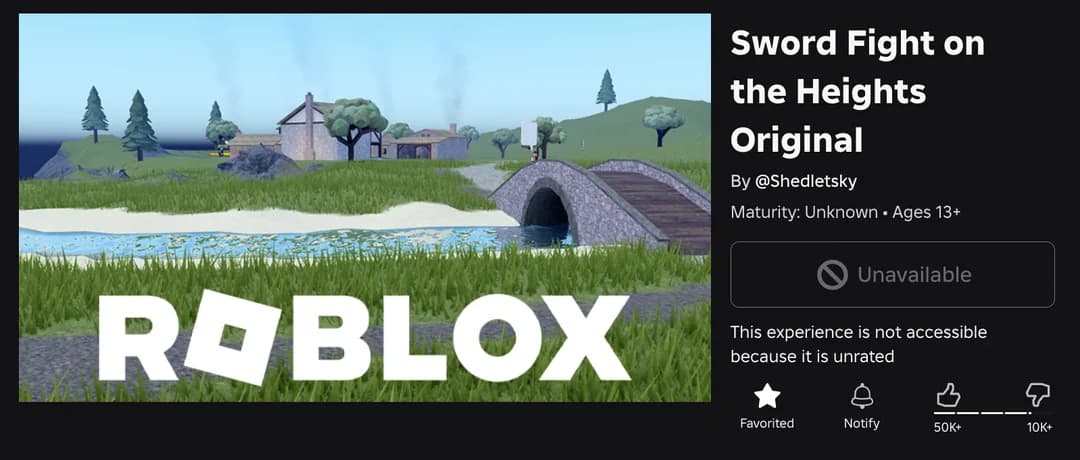
Players noticed that thousands of older or obscure experiences suddenly became unplayable—especially nostalgia maps, template-based places, and entries surfaced by place roulette style games. The timing coincides with Roblox rolling out enforcement that every public experience must have an age guidance rating generated via a developer questionnaire covering violence, chat, monetization, and other content dimensions.
If an owner never completes the questionnaire, the platform now blocks normal play access. This hits abandoned creations hardest: developers who left the platform years ago (or are deceased) obviously are not returning to fill out forms. That vacuum created the appearance of a mass deletion—hence the "purge" framing by the community.
Age guidance systems support regional compliance, app store policy alignment, and parental controls. A structured, self-attested form lets Roblox surface consistent content descriptors and apply age-appropriate restrictions. Without ratings, discovery and moderation pipelines have less context—especially for legacy places built before current policy frameworks existed.
While an automated heuristic scan might seem simpler, Roblox would assume liability for misclassification. By routing responsibility through the creator questionnaire, the platform reduces risk and gains structured data.
Reactions range from frustration ("preservation is dead") to strategic skepticism (claims the move is an optically fast moderation win). Players lament losing quick access to formative 2010–2016 era maps, gear- enabled arenas, and event hubs like early Creator Challenge spaces. Some worry cultural history is being fragmented. Others note that active, high-quality games are largely unaffected and that long-term consistency could help trust and monetization.
(We sampled public community discussion; quotations are paraphrased to avoid over-reliance on any single thread.)
A staff statement indicates that unique public experiences with ≥1,000 lifetime visits from inactive creators will be preserved. This implies an internal workflow to snapshot, assign or inherit a rating context, and republish or otherwise whitelist those places. The company frames it as a phased effort taking months. That means some classics will remain inaccessible in the interim.
Common community suggestions include auto-rating based on static heuristics, soft gating unrated games behind an age verification wall (e.g. 17+), or issuing staged warnings prior to hard block. Each has trade-offs:
Fast, but risk of misclassification & legal exposure for sensitive content.
Retains access for older players, but still leaves unrated data holes.
More creator goodwill, slower path to full coverage & policy certainty.
Expect waves: a first tranche of high-visit classics, followed by incremental batches as tooling/process stabilizes. Watch for DevForum updates clarifying edge cases (e.g. multi-place universes where only parent was rated). Community archiving projects may also catalog IDs for tracking. If Roblox publishes a public dashboard, that will accelerate transparency.
Is this the biggest removal event ever? It is one of the largest simultaneous accessibility shifts for legacy content, but most qualified classics should return under preservation.
Will favorites & visit counts reset? Roblox has not indicated resets; preservation implies continuity, but details may vary.
Does this affect private / unlisted test places? Private non-public projects are unaffected; the enforcement is for public experiences.
Can I still access via direct place ID? Launch attempts route through the same gating—if unrated, still blocked.
Are gear items now useless? Some utility declined, especially outside avatar arenas. Limiteds keep collector value; non-Limited gear may further stagnate.
Not affiliated with or endorsed by Roblox Corporation. All trademarks belong to their respective owners.
